
The Bottom Line
Small business is important to Central Oregon, and to Mid Oregon. Find tips and resources for business, and information about Mid Oregon’s commercial services and business members.
Challenges Beyond Credit Accessibility
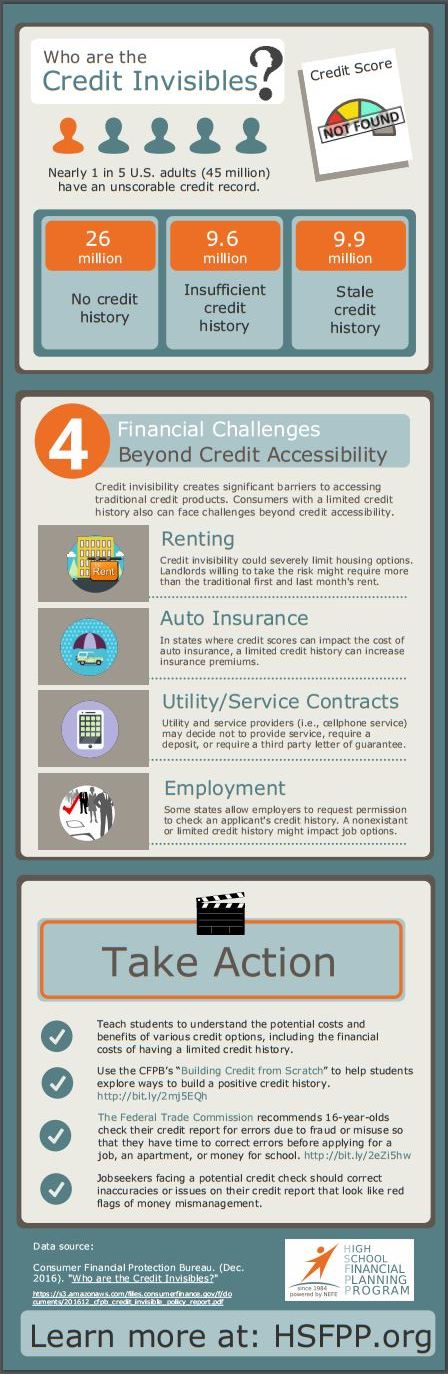
The Credit Invisibles: 4 Challenges Beyond Credit Accessibility
By: Kimberly Roy, National Endowment for Financial Education® (NEFE®).
I met a teacher at a conference recently who shared a viewpoint we sometimes hear from other educators. He claimed that students should be taught never to use credit. He said we should teach every student that if they can’t pay for school, a car, or even a house with cash, then they shouldn’t buy it. Unfortunately, this does not consider the complete picture of how credit impacts an adult’s financial landscape.
- This article, “The Credit Invisibles: 4 Challenges Beyond Credit Accessibility”, is written from the perspective of teachers or parents of teens or young adults. Much of the information also translates into actions for the reader as well.
HSFPP does not take a stand on whether credit should or should not be used. Instead, we encourage students to understand their options and the potential costs and benefits of their credit choices.
It’s important to tell students that credit itself is not good or bad, but how we use credit and manage debt can be beneficial or detrimental. Using a credit card to go on a spring break trip when the student does not have a job to pay back the card is very different than taking out a student loan to invest in a degree that could provide a higher income and pay for itself many times over.
Categories of Credit Account
Credit cards and traditional loans are not the only form of credit. In addition to revolving credit and installment loans, consumers use “open” credit accounts.
Open accounts are paid in full every month without a balance that rolls forward, and generally do not charge interest. These typically include utilities, cellphones and other service contracts. Most service providers only report to the credit bureaus when a customer has a late or missed payment. Rarely do these companies report positive monthly payments. Therefore these accounts can harm your credit score but rarely help it.
Limited Credit History: Financial Challenges Beyond Credit Accessibility
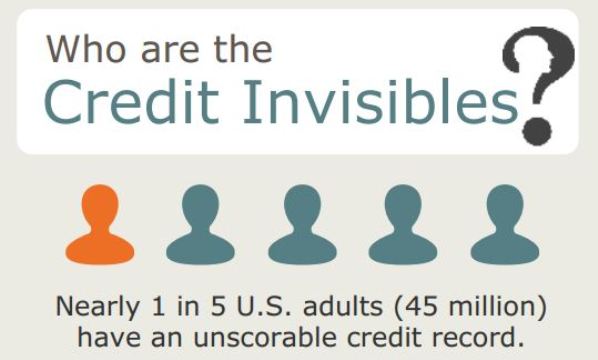
According to the Consumer Financial Protection Bureau (CFPB) Credit Invisible Policy Report, in 2015 almost 1 in 5 U.S. adults either did not have a credit history or had “unscorable” credit files (either due to insufficient history or lack of recent history). These people without credit are called the “credit invisible.” When looking only at young adults 18 to 19 years old, the rate of credit invisibility soars to between 64 and 67 percent.
Without a credit history, these 45 million credit invisible and unscorable consumers often are denied access to mainstream credit options. Even if an individual does not plan to have a credit card or take out an installation loan, being credit invisible still provides other significant challenges:
The High School Financial Planning Program® (HSFPP) is the flagship program of the National Endowment for Financial Education® (NEFE®). NEFE is the leading private nonprofit, noncommercial foundation dedicated to inspiring empowered financial decision-making for individuals and families through every stage of life.
Learn more about the complete suite of NEFE’s free consumer and educator resources at www.nefe.org.
Credit Invisible infographic 3-17 PDF
Deer Crossings and Identity Theft?
What do Deer Crossings and Identity Theft Have in Common?
by: Susan Sharkey, National Endowment for Financial Education® (NEFE®).
Defensive Driving Lessons and Defensive Consumer Tactics
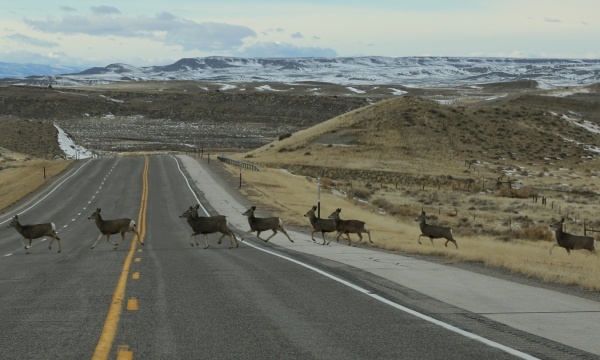
In drivers’ education courses, we are taught to drive defensively and watch for careless drivers — as well as anything else that might appear unexpectedly on the road. That training was especially relevant when I lived in Wisconsin and Minnesota, where one had to be vigilant to avoid contact with deer that periodically would dart across one’s path. What does deer crossings and identity theft have in common? More than you might think.
Both scenarios call for alertness to conditions that could lead to potentially costly and time-consuming inconveniences, including reporting mishaps and repairing damage. I am distrustful when put into a suspicious situation, whether scanning the road and shoulder to spot deer lurking in the shadows of trees, or skimming my inbox for unsolicited emails requesting my account information.
In both cases, I apply safeguards within my control. I sound my car horn to ward off deer from crossing the road at dusk, and I shred discarded mail and paperwork at home to deter theft of financial data or access to my account information. If something does happen — whether it’s a deer or fraud mishap — I act swiftly to file relevant reports and repair damage so my life returns to normalcy as soon as possible.
Higher Odds Than You Might Think
In 2016, State Farm Insurance reported the odds of hitting a deer while driving in Wisconsin to be 1 in 77 drivers. With those odds, it seems only a matter of time before I would have a deer-auto incident. Similarly, it is not a matter of if identity fraud will happen; rather, it is more likely a matter of when it will happen.
Data from the Javelin Strategy and Research 2017 Identity Fraud Study revealed that 2016 saw the highest number of victims — 6.15 percent of consumers (15.4 million) – reporting nearly $16 million in losses due to identity fraud. Consumer fraud is the fastest growing crime in the U.S., costing twice as much as property crime, according to the U.S. Bureau of Justice and Statistics. In addition to victim costs, many hours are spent filing reports with police and creditors, verifying and fixing account information, replacing lost items and conducting investigations.
Much like defending against deer collisions, defensive tactics can and should be applied to minimize damage caused by fraud. Whether or not you or a family member have been a victim of identity fraud, be aware of sensible precautions and credible resources to protect against and remedy circumstances of fraud.
The High School Financial Planning Program® (HSFPP) is the flagship program of the National Endowment for Financial Education® (NEFE®). NEFE is the leading private nonprofit, noncommercial foundation dedicated to inspiring empowered financial decision-making for individuals and families through every stage of life.
Learn more about the complete suite of NEFE’s free consumer and educator resources at www.nefe.org.

Six Rules for Managing Credit Card Debt
If you want to be the master of your credit card debt load, follow these key six rules for managing credit card debt:
1. Take inventory. How many credit cards do you have? What’s the balance and minimum monthly payment on each? What’s the total balance? If it’s more than you thought or can afford, it’s time to pare down.
2. Check out the cost of your credit cards. What’s the interest rate on each card? What’s the annual fee? Does your card offer a grace period? If the card doesn’t have a grace period, or if you carry over a balance, or take a cash advance, you’re usually charged interest right away.
3. Get one low-fee or lower-interest card and use it wisely. Make Mid Oregon Credit Union your first stop when starting your search. Check to see if you can transfer existing debt from your various credit cards to your new lower-interest credit card.
4. Make the largest monthly payment you can afford. Even though you may not be able to pay your balance in full, paying the monthly minimum may do little more than cover the accrued interest. Ever heard about the “Debt Snowball”? It may do the trick for you.
5. Watch out for “teaser rates.” Your mailbox may be brimming with unsolicited credit card offers that promise attractive low-interest rates. But if you read the fine print, you’ll see that after six months or so the issuer may double the low introductory rate.
6. If you get in over your head, don’t bury it in the sand. It’s a good idea if you’re having trouble making your monthly payments, contact your creditors before they contact you. And, if you’re already screening calls from bill collectors, or refusing to open your mail, you need help.
It might be worth your time to talk to a Mid Oregon Loan Officer about different options to help you get out from under heavy credit card debt. Email, call (541) 382-1795 or visit our website for more details.